
Flamingo Friday
July 2025

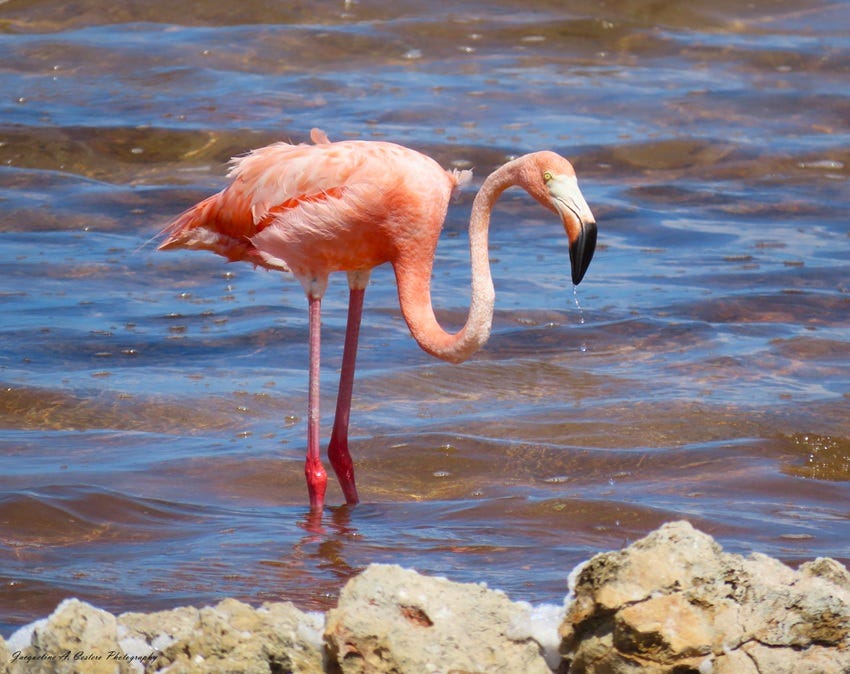
Our visiting American Flamingo has been making appearances on the West End over the last few months. The moments have been fleeting, like the Flamingo Flyover in June. Thanks to an alert by my friend Janice Isomura, I was able to spend some quality time with our vision in pink on Sunday.


Janice shared a video noting that the American Flamingo was on West End Pond at that moment. We rapidly mobilized to the site to find the bird happily feeding among a small number of shorebirds.
A small flock of Least Sandpipers was in the area. Most were in breeding plumage, indicating that they had recently migrated to our shores.


Our Flamingo was constantly interrupted by a male Black-necked Stilt. Although we could not identify a nest or chicks, he was displaying defensive behaviour. The American Flamingo wasn’t impressed with his maneuvers.
A little voice in my head had the bird saying - “Do you have any idea who I am? Out of my way, squirt!”
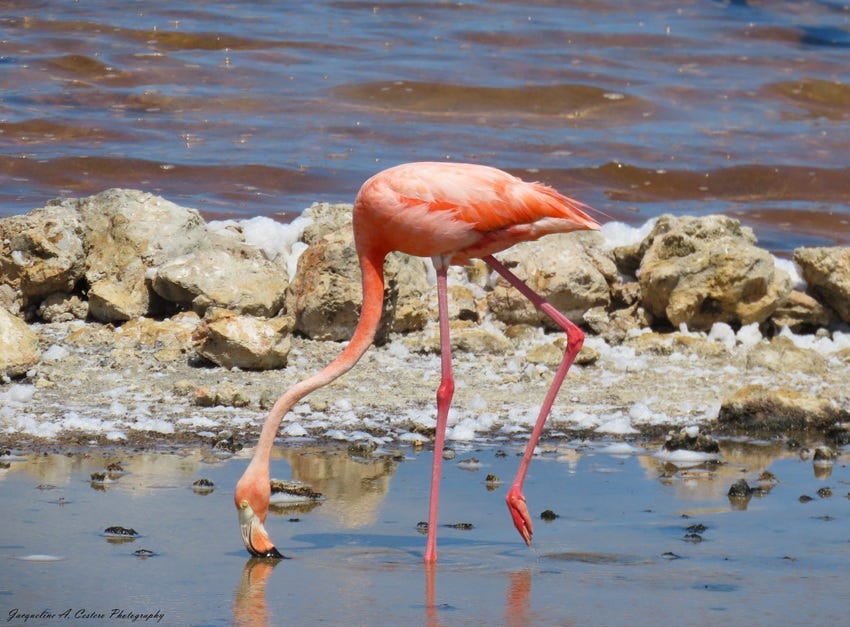
This bird spent the majority of its time feeding back and forth along the outer edge of West End Pond.
One of the common questions is: “What do American Flamingos eat?” As always, Birds of the World gives us the full picture:
“Relatively varied diet. Animal food consists of aquatic invertebrates, e.g., crustaceans (Artemia, Gammarus, copepods), molluscs (Cerithidea, Cerithium, Paludestrina, Neritina, Gemma, Macoma), annelids (Nereis), and insects, including larvae or chrysalids of Diptera (Ephydra, Chironomus, Thinophilus) and corixids (Sigaria, Micronecta); plant matter consists largely of seeds or stolons of marsh grasses (Ruppia, Scirpus, Juncus, Cyperus), also algae, diatoms, and decaying leaves. Occasionally takes adult insects, e.g., waterbeetles (Coleoptera) or ants (Formicoidae); also crabs (Dotilla) and perhaps small fish (Cyprinodon). Sometimes ingests mud, in order to extract organic matter, especially bacteria.”
It also has a unique feeding style. All about Birds provides the following simple explanation.
“Individuals forage by holding their head underwater as they slowly stride along in shallow lagoons and estuaries. As the head moves through the water, they use their large tongues to push water through comblike structures (called lamellae) in their bills, filtering out small food items. This is very similar to the way whales strain out crustaceans using their baleen.”
I hope you enjoy today’s companion reel. The wind was a bit of an issue. Hopefully, the music will cheer you up too!
One of the great things about seeing American Flamingos on Anguilla is their unpredictability. You never know when or where they will turn up. But when they do, the joy is palpable in everyone who experiences their presence.
I don’t think you can ever have too many Flamingo Fridays!
Many thanks to my friend and Wild Side News supporter, Janice, for bringing this bird to my attention. It was great to share a special afternoon and her first time seeing the Flamingo in person.
Have you seen the American Flamingo on Anguilla recently? I would love to hear about your experiences in the comments below.
So much fun and what a video. You really caught this flamingo in its bright colours! Thank you for sharing.
Beautiful! 💕